The chain format
This is a reference for a file you mostly do not write. An agent is a Markdown declaration; contenox generates the chain behind it and keeps it in step with the file you edited.
You come here for two reasons. To read one — the chain is the audit artifact, the single place that says which model runs, which tools are on the table, and where the run can go next. And to write one, when a declaration cannot say what you need it to: a branch, a different model per step, a recovery path, a declared point where a human stands. Then the engine runs exactly what you wrote.
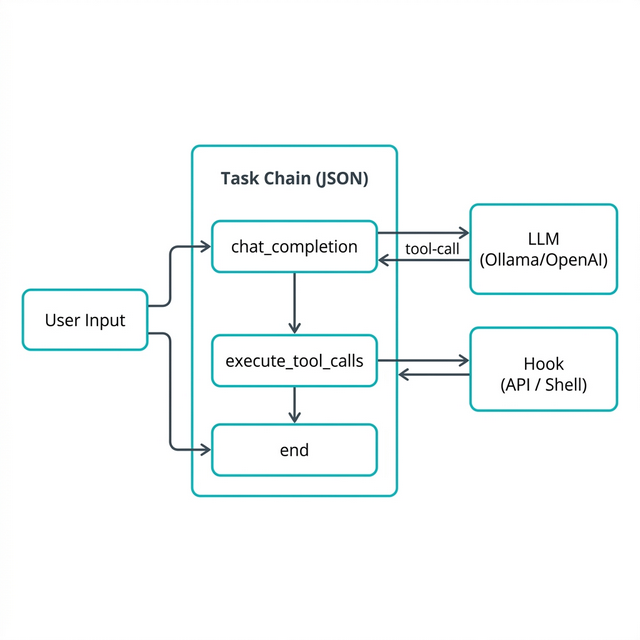
Chain structure
{
  "id": "my-chain",
  "description": "What this chain does",
  "tasks": [ /* TaskDefinition[] */ ],
  "token_limit": 8192,
  "debug": false
}| Field | Type | Description |
|---|---|---|
id | string | Unique identifier |
description | string | Human-readable description |
tasks | TaskDefinition[] | Ordered list of task definitions |
token_limit | int | Context budget for the chat history, and the source of the per-call tool-result cap. Set it. See below. |
debug | bool | Enable verbose task-level logging |
token_limitalso sizes tool results. The largest result a tool may return is derived from what is left of this budget after the chat history. Omitting the field does not mean “no limit” — it leaves the budget at zero, so every tool call comes back astool_result_too_largeno matter how small the real result is. A chain whose tools all report that error is missing itstoken_limit.
Task structure
{
  "id": "step_name",
  "description": "What this task does",
  "handler": "chat_completion",
  "system_instruction": "...",
  "execute_config": { },
  "transition": { "branches": [ ] },
  "retry_on_failure": 0,
  "timeout": "30s"
}| Field | Type | Description |
|---|---|---|
id | string | Unique identifier for this task |
description | string | Human-readable summary of what the task does |
handler | string | Handler type — see Handlers |
system_instruction | string | System prompt (supports template macros) |
execute_config | object | Model, provider, tools, and execution policy settings |
transition | object | Branching rules — see Transitions |
retry_on_failure | int | Number of times to retry if the task errors (default: 0) |
timeout | string | Per-task timeout, e.g. "30s" or "2m" |
See Handlers and Transitions for the full field reference.
Sections
- Handlers — all task handler types and their fields
- Transitions & Branching — how the chain decides what to do next
- Annotated Examples — full working chains with commentary
- Writing a chain by hand — the walkthrough, when you have decided you need one