Beam Desktop: the client as a peer
Where the original Beam was a web app served by the runtime, Beam Desktop inverted the relationship: the client became the host. The window was loaded from disk over file:// — the nginx config deleted, the contenox serve embed path retired — and the runtime was spawned as a child process and spoken to over stdio. No port, no localhost binding, no HTTP server anywhere in the loading path. The codec was NDJSON, one JSON-RPC message per line, which is exactly what libacp already reads and writes; the desktop shell added no transport of its own.
The renderer had no Node access at all — sandbox: true, contextIsolation: true, nodeIntegration: false — and reached the runtime through a preload bridge exposing exactly four things: send, onMessage, onClose, onStderr. No filesystem, no child processes, no way to name the binary being executed. Owning the child process is also what made ACP’s env_var authentication method usable for the first time: “relaunch me with these variables” can only be answered by whoever spawned the process. The variables the renderer could inject were allowlisted by prefix — CONTENOX_* and *_API_KEY — deliberately not taken from the runtime’s own advertisement, since that advertisement arrives over the same bridge the renderer talks on and a compromised renderer must not be able to set PATH on a binary the main process spawns.
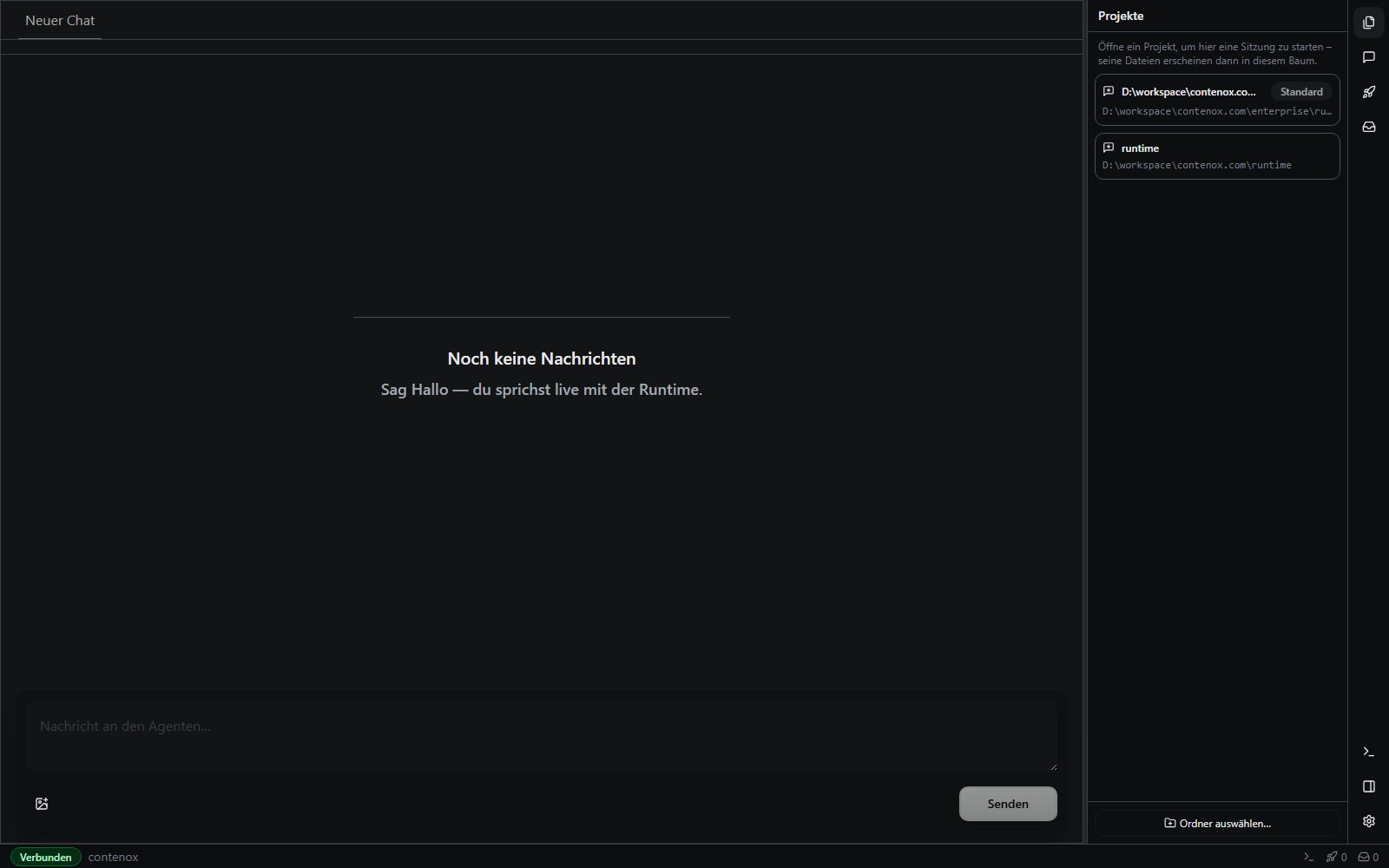
The shell against a runtime that had no default model configured. The status pill reports the pipe, not the engine — one of the defects that made the case for finishing the capability contract before building a client on top of it.
The architectural centerpiece was one bus. editorbus re-hosted a recovered VS Code agent’s dispatch onto the NDJSON pipe, and contenox acp handed libacp a multiplexer rather than raw stdio: it read the pipe once, answered the editor method family itself — workspace roots, git status and diff and per-hunk staging, cancellable search, host terminals, model and provider catalogs, config, missions, inbox — and forwarded everything else verbatim. ACP methods, notifications, responses, and unknown methods all passed through untouched, so a methodNotFound came from libacp’s own dispatcher rather than a silent drop. initialize was never claimed by the editor half: a second definition would fork the protocol on a single connection. Verified against the real contenox acp binary over one connection — ACP initialize at protocol version 1, an editor autocomplete dispatched, a mission list, editor health, fifteen commands, and an unknown method correctly answered -32601.
What it proved
- A desktop client can be a peer of the runtime rather than a payload it serves. Removing HTTP from the loading path removed an entire class of question — which port, which origin, which cookie, which handshake — rather than answering it better.
- One stdio pipe carries a standard protocol and a private method family without forking either. ACP becomes the part of the vocabulary that happens to be standard, not the ceiling on what the connection can express.
- The spawning process is the only place an env-var auth method can be honoured, and the allowlist for it belongs on that side, never in the advertisement the renderer relays.
- A client cannot be finished before the contract it consumes is. Roughly 28 editor-bus methods were reachable from this shell and from no other surface, while the terminal UI reached around ACP into services directly — including a second, independent file browser. Every capability had two homes and neither was canonical. No amount of work in the shell could fix that, because the defect was underneath it.
Where this lives now
The shell itself was not kept: about 42,800 lines of TypeScript, generated in roughly a day, past the point where it could be reviewed and therefore owned. What it surfaced was kept and is in the runtime today — a ConPTY backend that took shell sessions on Windows from absent to working for the terminal UI and ACP alike, session vitals promoted from a TUI widget into a runtime service, and the git review service.
The finding outlives the client. acpsvc’s editor bridge is the pattern the consolidation pointed at: a capability is defined once in ACP core and re-exported to the editor family, so the terminal UI and any editor are the same kind of consumer. That seam is the work; the next client gets written by hand, small, against a contract that has stopped moving.