beam: the terminal client
beam was a full-screen terminal client for agent sessions: chat, plan, shell
and file edits in one scrollback, an approval card that blocked a gated tool
call inline, a command palette with argument completion, @ file addressing,
and a status bar carrying the live model, session and context pressure.
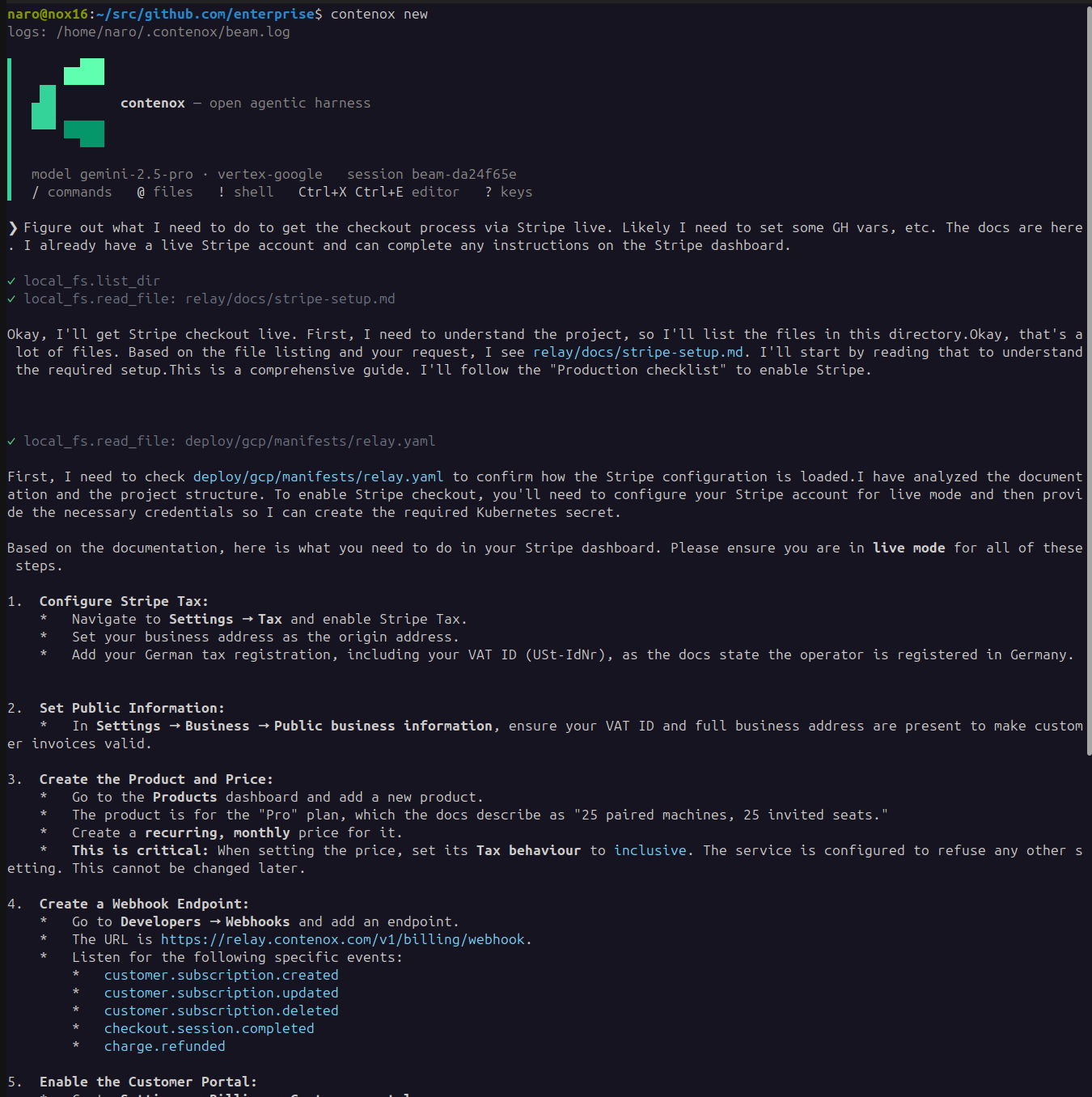
It was the instrument that exercised every seam of the system from a client’s side.
What it settled
- The seam is the protocol, not the surface. Almost none of beam knew which agent it was talking to. What it had been all along, without being asked to be one, was a client for the Agent Client Protocol.
- A surface must not own policy. Where beam did reach past the protocol, that was a governance boundary having quietly come to live inside a client. A boundary that only holds while one particular surface is running is not a boundary.
- Argument completion belongs to the protocol. Beam’s command palette filled its value domains from what the agent already advertised — the same thing a browser client receives. Nothing had to be added to the protocol for it, and the web client was built from beam’s model rather than designed fresh.
Addendum, 2026-08-18: the conclusion was drawn one step too far
This record closed by retiring the client, and the reason given at the time was that the best shape for using contenox is not a terminal. That was an overreach. It read a defect in where the boundary sat as a verdict on what the surface was, and the two were never the same claim.
The finding that held is the second one above: a surface must not own policy. Beam reached past the protocol, so a governance boundary lived inside a client, and a boundary that only holds while one particular process is running is not a boundary. Retiring the client did make that specific instance go away. It did not fix anything — the next client would have grown the same reach, because nothing underneath it was answering the question.
What answered it was the durable ask. A gated call now becomes a row and a checkpoint before any surface renders anything: the verdict is recorded once, by compare-and-swap, and the run resumes from the checkpoint exactly once, whether the answer came from a terminal, an editor, or a phone three days later. The policy is enforced under every client rather than by the one in front of you. With the boundary moved, the reason to have no terminal client expired, and what was left was the part of beam that was always good: a person at their own keyboard, in their own scrollback, with the gate visible in front of them.
So beam is back in-tree, as the first-party client and the front door —
contenox beam, and bare contenox on a terminal. It is not this client
restored; it is a client written against a contract that had stopped moving,
which is what Beam Desktop said the next one would
need. The lab record above stands as written. Only its closing verdict is
withdrawn.