Beam: the bundled web UI
Beam is the web UI that ships inside contenox. Run one command and the runtime
you already drive from the terminal opens in the browser: the same sessions, the
same chains, the same model and provider config, the same HITL policies. Nothing
is hosted — Beam is served by your local contenox serve process, reads and
writes the same SQLite state as the CLI, and stays on 127.0.0.1.
It is the product’s face for work you want to watch: you see the workspace the agent is bound to, which files its policy lets it touch, every tool call as a card, and — before any gated write or command runs — a diff you approve or reject yourself.
The whole loop in 30 seconds: a prompt in a project workspace, the agent reads the files, the gated write pauses at the approval gate with a diff, one keypress approves it, and the agent-view overlay shows what the policy lets it touch.
1. Start Beam
If you have not installed Contenox and configured a model yet, do the Quickstart first — Beam needs a working model like any other entrypoint.
Install (macOS / Linux):
curl -fsSL https://contenox.com/install.sh | shInitialize a workspace once, in the project directory you want to work in:
contenox initThen start the server from that directory and open the printed URL:
contenox serve
# Contenox serve <version> ready: http://127.0.0.1:32123
Beam is now at http://127.0.0.1:32123. The server binds to 127.0.0.1:32123
by default; override with the ADDR and PORT environment variables. A bearer
TOKEN is optional on loopback and mandatory when you bind a non-loopback
address.
Remote access and login
When a TOKEN is set (required for any non-loopback bind), Beam gates the whole
UI behind a login page: opening the site shows a single Access token field.
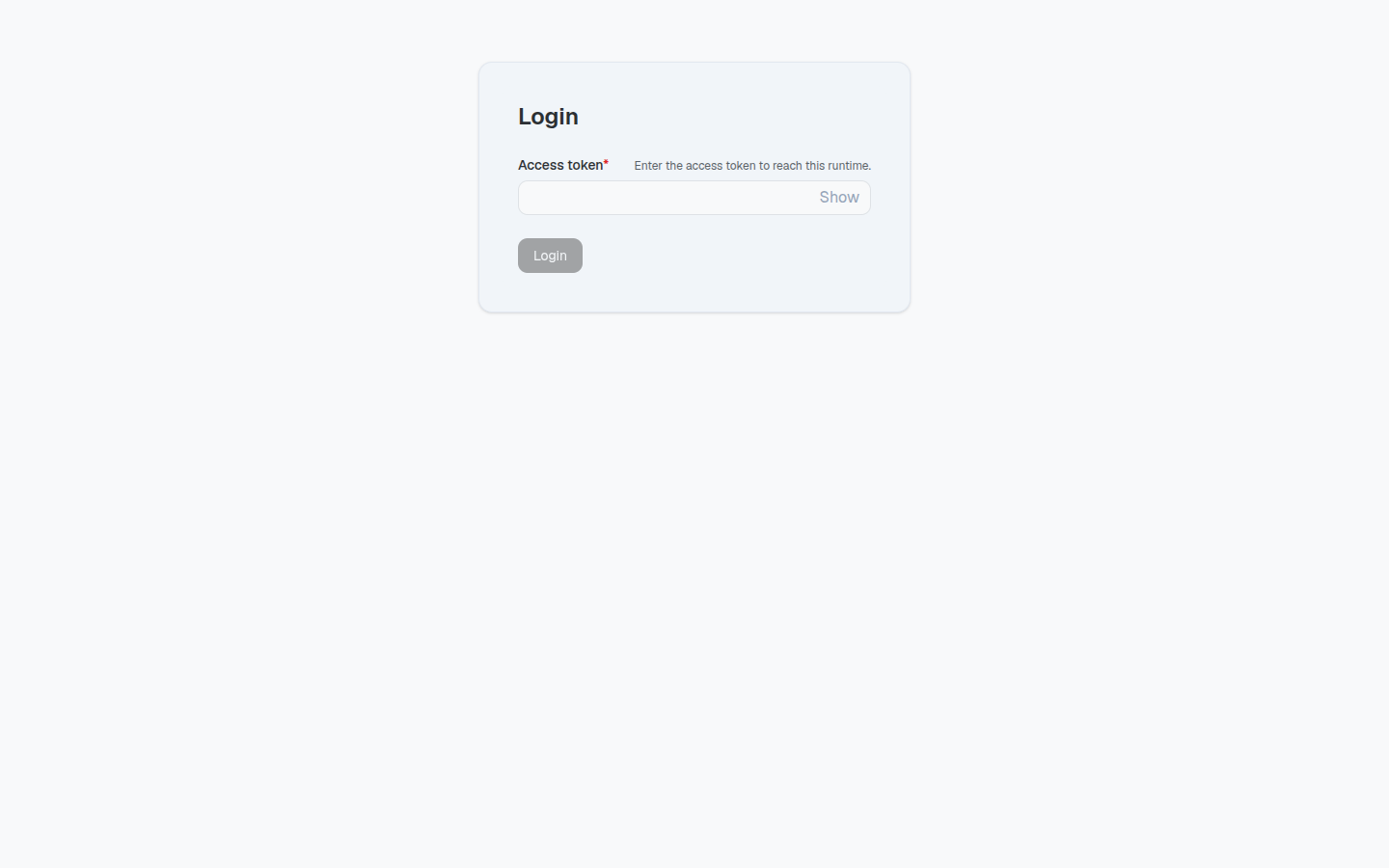
Paste the configured TOKEN and the server verifies it (constant-time) and
returns a secure, HttpOnly session cookie — SameSite=Strict, and Secure
whenever the connection is HTTPS (including behind a TLS-terminating proxy that
sets X-Forwarded-Proto: https). The token is never stored in the browser’s
localStorage or placed in the URL; the cookie rides automatically on every
same-origin request, including the /acp chat WebSocket upgrade. Sign out from
Settings → Remote access, which clears the cookie and returns you to the
login page.
Programmatic clients are unaffected: they keep authenticating with an
Authorization: Bearer <TOKEN> (or X-API-Key) header, and the ACP WebSocket
still accepts a ?token= query parameter. On loopback with no TOKEN, no login
is required and the UI loads with zero prompts.
Allowlisting project directories
The directory you run contenox serve in is always available as a session
workspace — it is the default root. To let a browser session pick other
project directories as its workspace, extend the allowlist. Any of these work,
and they combine:
# Positional arguments — additional roots after the serve directory:
contenox serve ~/code/api ~/code/web

# Repeatable flag:
contenox serve --workspace-root ~/code/api --workspace-root ~/code/web

# Environment (OS path-list separated, ':' on Unix):
WORKSPACE_ROOTS="$HOME/code/api:$HOME/code/web" contenox serve
A session can only ever choose a workspace inside this allowlist — it bounds what any browser client can reach.
2. A tour of the window
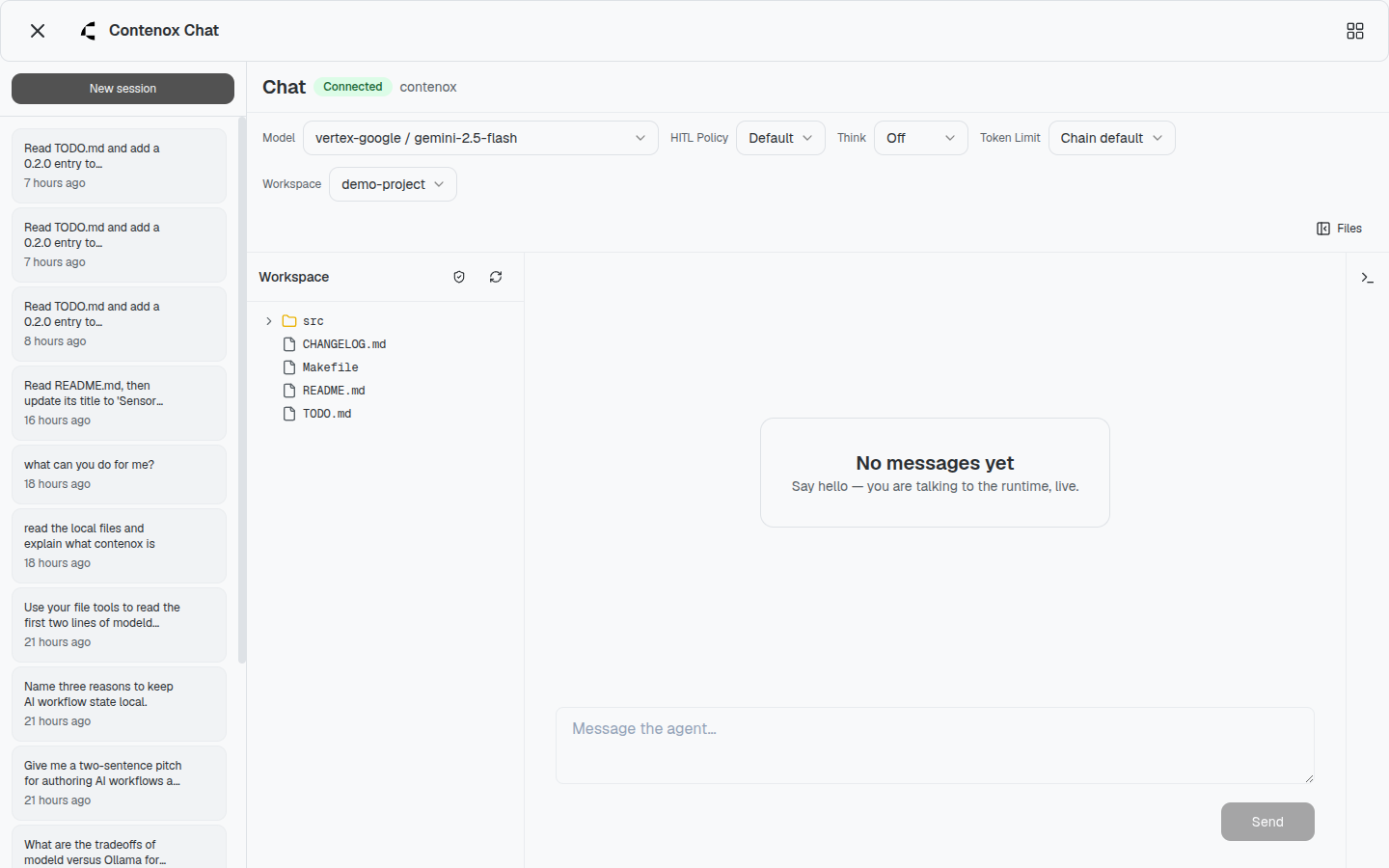
Session sidebar
The left sidebar lists your chat sessions. New session starts a fresh one; each row links to its conversation and carries a delete button. These are the same sessions the CLI sees — see step 3.
Next to New session is a chevron — New chat with an agent. It only
appears once you have registered an external ACP agent,
and it opens the agent picker below. A session
started against an external agent carries that agent’s name (Agent: {name}) on
its sidebar row, so you can tell at a glance which sessions ran on the native
runtime and which drove a foreign agent.
Per-session controls
Each session has its own configuration, shown in the chat toolbar (collapsed under an Options dropdown on narrow viewports):
| Control | What it sets |
|---|---|
| Model | The model this session runs on. |
| HITL Policy | The named HITL policy that decides which tool calls pause for approval. |
| Think | Reasoning effort — Auto, Off, Minimal, Low, Medium, High, or XHigh. |
| Token Limit | The per-turn output token budget. |
| Workspace | Which allowlisted directory (see step 1) the session is bound to — chosen on the empty chat before the first message, immutable afterwards. |
Changing a control affects only that session, so you can keep one session on a local model with a strict policy and another on a hosted model — side by side.
Chat with a registered agent
Beam is not only a face for the native runtime chain — it can also drive any external ACP agent you have registered (Claude Code, Goose, a home-grown one) from the same window, gated by the same approvals.
- Register an agent from the CLI once —
contenox agent add <name> -- <command>(or seed one from the catalog withcontenox agent add <registry-id>), thencontenox agent check <name>to confirm it answers. See the CLI reference. - In the sidebar, click the New chat with an agent chevron. The picker lists Contenox (default) — the native chain — at the top, then every enabled registered agent.
- Pick an agent and the empty chat stages it: the greeting reads “Say hello — you are talking to {name}, live”, and the session is bound to that agent the moment you send the first message. The binding is fixed for the life of the session — an agent is chosen at creation, never switched mid-conversation, so there is no in-chat agent switcher.
An external-agent session’s toolbar surfaces the config options that agent advertises for the session — for example a Claude Code session exposes its own Mode and Model pickers — alongside contenox’s own HITL Policy control, so the contenox approval gate still applies to a foreign agent’s gated actions. (The native runtime’s per-session Model / Think / Token-Limit controls do not apply to an external agent and are not shown.)
The agent’s turns stream into the transcript like any other, its tool calls render as cards, and any permission request it raises becomes the same inline card described below.
Workspace file tree and the agent-view overlay
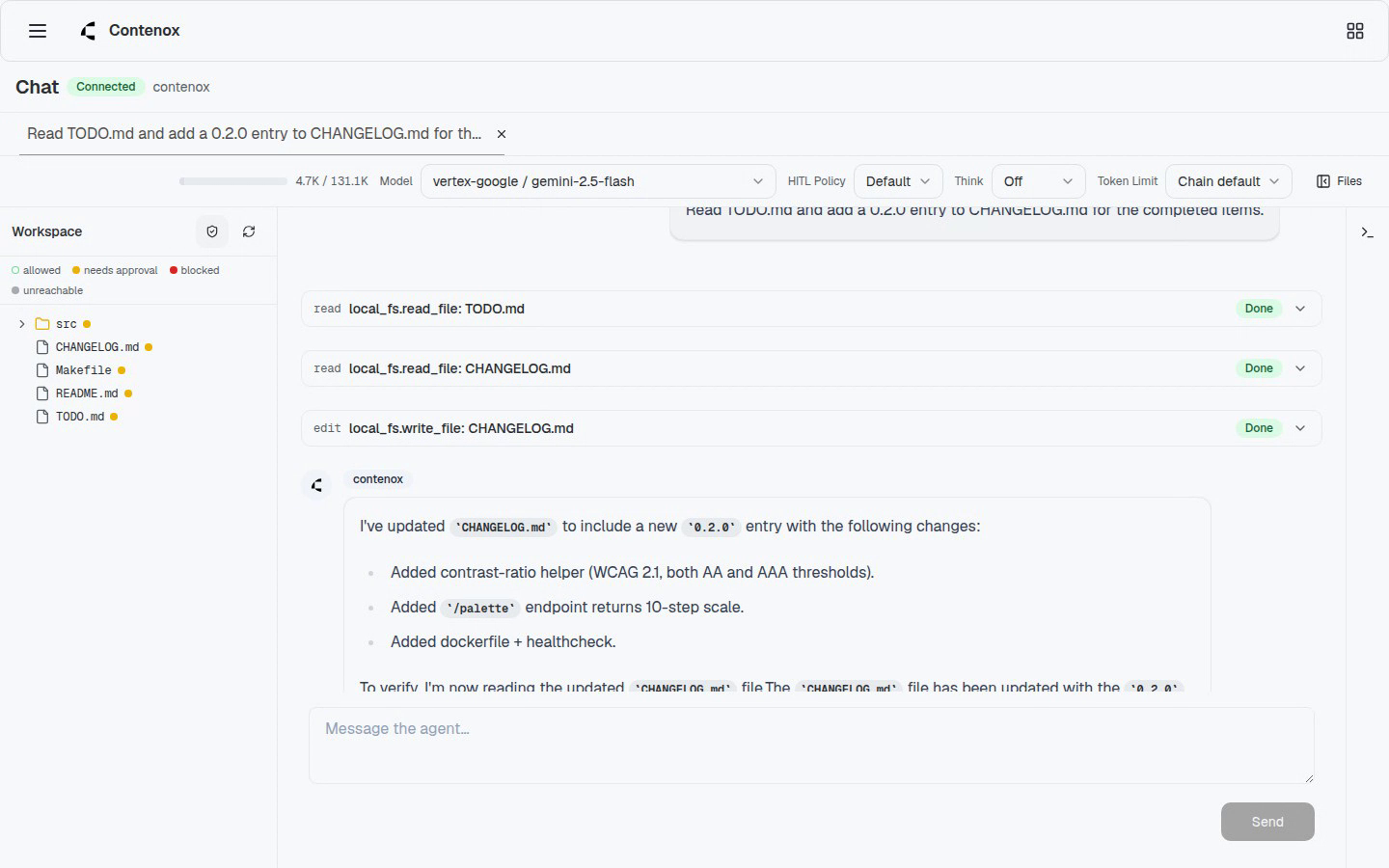
The Files toggle opens the Workspace panel: a lazy file tree of the session’s chosen workspace. Click a file and it opens as a read-only tab beside the chat; directories expand in place.
The tree has an Agent view toggle (the shield button). Turn it on and Beam overlays each file with the verdict the session’s HITL policy would return for it — computed from the same policy source the live agent uses, so what you see is what the agent gets:
- allowed — the agent may act on this file without a prompt
- needs approval — a matching call pauses at the approval gate first
- blocked — the policy denies it outright
- unreachable — outside the workspace boundary; the agent cannot see it
It turns “what can this agent touch?” from a question you have to reason about into something you can read off the tree before you send a prompt.
Files and the terminal as tabs
Opened files and the terminal live as tabs in the canvas region beside the chat.
The Terminal tab streams a PTY rooted at the session’s workspace; type !
followed by a command in the chat to run it there, and when the agent itself runs
a shell command mid-turn its output streams into this same tab — every shell line,
yours or the agent’s, runs through the runtime’s own workspace shell. (Terminal
API routes are on by default for local serve; set TERMINAL_ENABLED=false on the
serve process to disable them.)
Composer shortcuts
The prompt composer understands three inline prefixes:
@opens the mention menu — attach a workspace file to the prompt by name, with a live preview of the highlighted file./opens the command suggestions menu of the slash-commands the active agent advertises. The native runtime and a registered external agent each surface their own command set here; picking one drops it into the composer.!runs the rest of the line as a shell command in the workspace Terminal tab (above), with no LLM turn.
The approval gate
When a tool call matches an approve rule in the active HITL policy, the run
pauses and Beam raises an inline permission card — a warning-styled card that
appears in the transcript flow, anchored to the pending tool call it belongs to,
so the request lives exactly where it happened instead of floating over the page.
The card shows the action’s kind and title, the target paths (path:line), a
diff of a pending file write, and the raw tool input under a collapsible
toggle.
You answer by clicking one of the offered buttons — typically Allow or Deny, plus their always variants when the policy offers them (each with a keyboard shortcut). Nothing else responds: clicking elsewhere, pressing Escape, scrolling, or switching tabs never answers the request — an unanswered request simply stays pending, which is the correct behaviour (the agent waits). This is deliberate. The gate is no longer a modal you could accidentally dismiss, and the old “click outside to deny” footgun is gone; there is likewise no maximize-to-tab step — the card is already inline.
Nothing gated runs until you say so, and the decision is recorded in the session transcript alongside the tool-call card, where the card itself persists. Because each open session carries its own card, a permission waiting in a background session surfaces an Approval needed marker on its sidebar row, so it stays discoverable while its tab is out of view. Failed turns render inline error cards (with a Show details toggle) instead of vanishing, so a session is a durable, reviewable record — tool-call cards, diffs, approvals, and errors all survive a reload.
3. Shared with the CLI
Beam is a view onto the runtime, not a separate app. The sessions you start in the browser are the sessions the CLI lists:
contenox session list
contenox session switch <name>
The same holds for the same work everywhere else: the chains you run in Beam are the chains you run from the terminal, from the VS Code extension, or from any ACP editor. One runtime, one set of sessions and policies, many front ends.
Next steps
- HITL policies — author the rules the approval gate and agent view enforce
- Your first chain — package repeatable work as a reviewable JSON contract
- Core concepts — how chains, tasks, and tools fit together