Task Chains
A task chain is a JSON state machine that defines how the AI agent behaves end-to-end. Chains are composable, inspectable, and backend-agnostic.
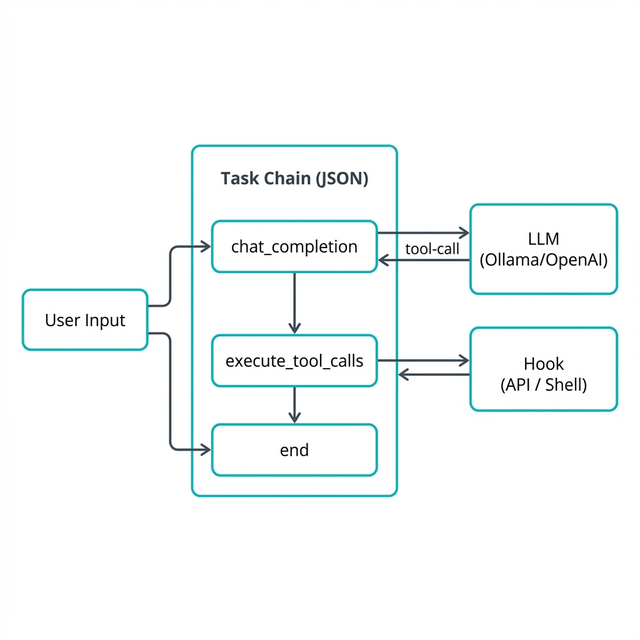 Task Chain Execution Flow
Chain structure
{
  "id": "my-chain",
  "description": "What this chain does",
  "tasks": [ /* TaskDefinition[] */ ],
  "token_limit": 8192,
  "debug": false
}
| Field | Type | Description |
|---|---|---|
id | string | Unique identifier |
description | string | Human-readable description |
tasks | TaskDefinition[] | Ordered list of task definitions |
token_limit | int | Max token budget for the chat history |
debug | bool | Enable verbose task-level logging |
Task structure
{
  "id": "step_name",
  "description": "What this task does",
  "handler": "chat_completion",
  "system_instruction": "...",
  "execute_config": { },
  "transition": { "branches": [ ] },
  "retry_on_failure": 0,
  "timeout": "30s"
}
| Field | Type | Description |
|---|---|---|
id | string | Unique identifier for this task |
description | string | Human-readable summary of what the task does |
handler | string | Handler type — see Handlers |
system_instruction | string | System prompt (supports template macros) |
execute_config | object | Model, provider, tools, and execution policy settings |
transition | object | Branching rules — see Transitions |
retry_on_failure | int | Number of times to retry if the task errors (default: 0) |
timeout | string | Per-task timeout, e.g. "30s" or "2m" |
See Handlers and Transitions for the full field reference.
Sections
- Handlers — all task handler types and their fields
- Transitions & Branching — how the chain decides what to do next
- Annotated Examples — full working chains with commentary