
Replit Missions and Google Stitch Loop: what can AI do after you close the laptop?
A shop owner wants to know why customers leave at checkout. Replit offers a team of AI agents to investigate. Google offers a way to keep watching what happens after a fix.
By Contenox
Imagine running an online shop. Customers put things in their baskets, reach the payment screen and leave. A chatbot can give you a list of possible reasons. Someone still has to look at the shop’s records, try a change and come back a week later to see whether more customers finished paying.
That gap is what two November launches aim to close. Replit Missions lets a team give AI a job with a finish line and a budget. Stitch Loop, an experiment from Google Labs, looks for ways to improve software that people are already using. Both use agents: software that can take steps such as reading records or changing code using tools it has been given. Here’s what that could mean for the shop. Replit’s announcement · Google Labs’ announcement
Replit Missions takes on a project#
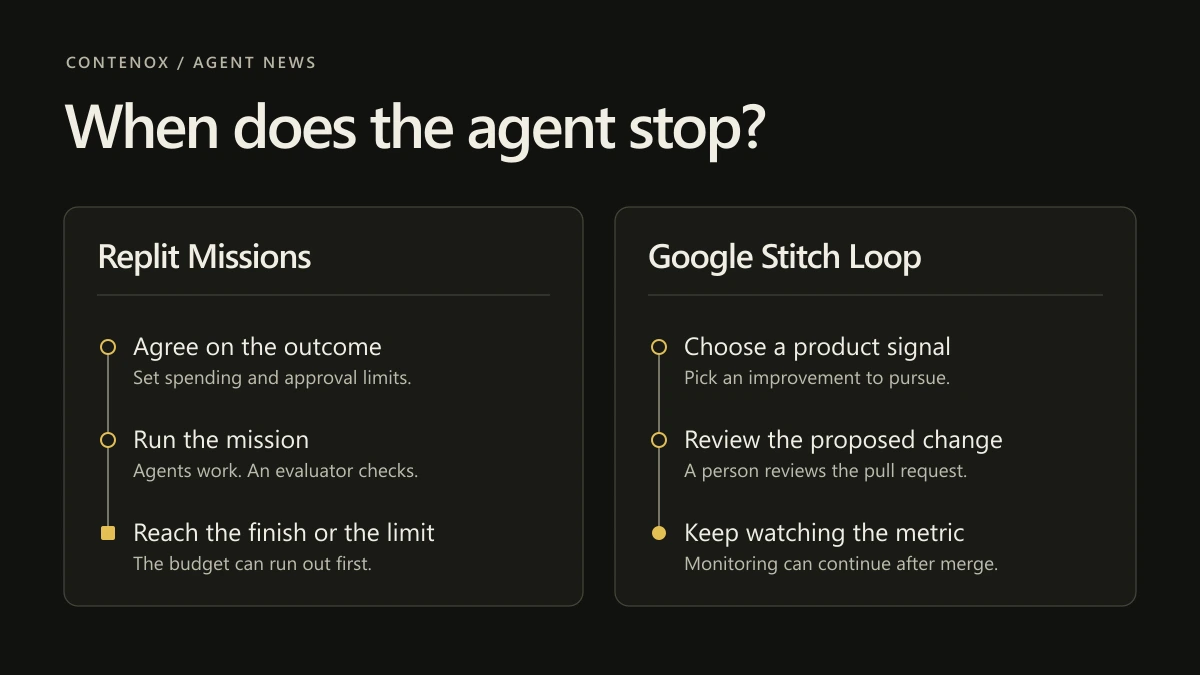
Replit is a platform for building and running software. It introduced Missions on November 17 for work that takes many steps and repeated checks. A person describes the desired result, agrees how to measure success, sets a spending limit and chooses which decisions need approval. Replit runs several agents in the cloud, so the person can close their laptop while work continues. Introducing Replit Missions
For the shop, an assignment might be: “Find where mobile shoppers leave checkout. Prepare a change and show that it helps. Ask before changing the live store.” One agent could examine where people leave. Another could prepare a simpler payment screen. Before judging success, the owner would need to decide what counts. If the goal is more completed payments, a prettier screen alone earns no credit.
Replit says a separate AI evaluator compares the work with the agreed criteria. A mission can stop because the criteria are met, the budget runs out or a decision needs a person. The practical appeal for a small team is having someone carry the investigation from one step to the next. The owner still decides whether the evidence warrants changing the shop. Replit’s Missions page offers a launch button and explains billing. Its public FAQ does not specify which subscriptions include access. Missions access and FAQ
Google Stitch Loop follows the product after launch#
Google Labs announced Stitch Loop on November 18 to help teams maintain software after they ship it. A team connects its code and information about how people experience the product. That might include page-load times, customer feedback or records of where people abandon a purchase. Loop uses those signals to suggest something worth changing. How Stitch Loop works
Suppose mobile payments started taking longer after the shop added a shipping calculator. Loop could suggest investigating that change. If the developer chooses that direction, Loop prepares an edit in a separate environment and submits it for review on GitHub, where the team keeps its code. The developer can see the proposed edit before accepting it. After release, Loop can watch how long real payments take and flag a slowdown if it returns. Google opened a worldwide waitlist, with priority for eligible Google AI Ultra users. Stitch Loop waitlist
Why a small team might care#
If the checkout has never worked well and nobody has time to investigate, Missions offers a way to commission a bounded piece of work. If checkout was fast last week and gradually got worse, Loop offers a way to notice the slip, propose a repair and watch the result. Either way, the shop needs a measure it trusts and a person who can decide when to put a change in front of customers.
The shop example illustrates the companies’ launch descriptions. Contenox.com hasn’t run a checkout trial with either product. For more on the tools these agents use, see What is an AI coding agent?.